
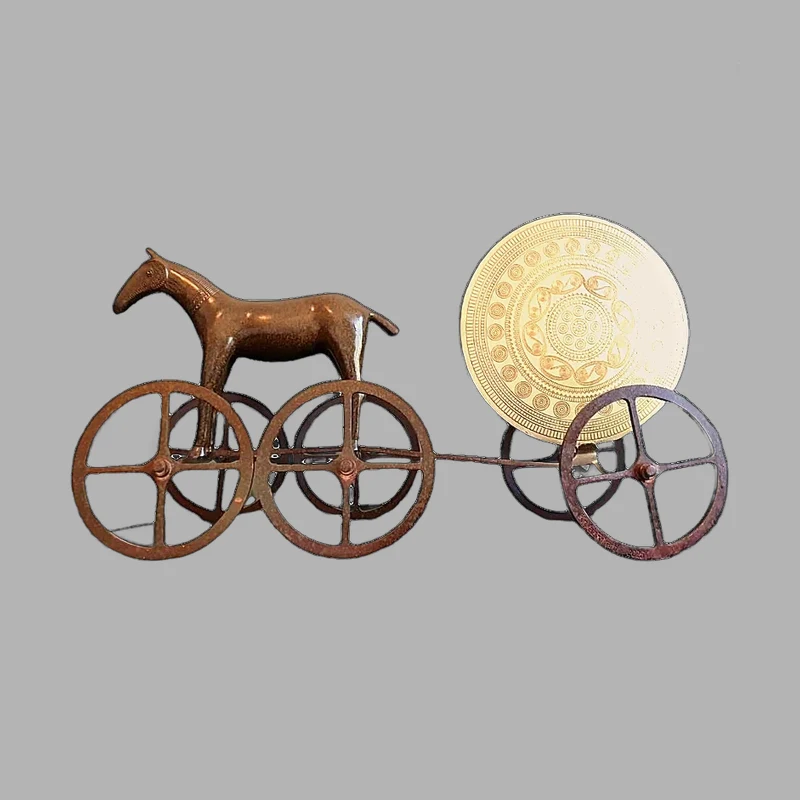
The Sun Chariot (Solvognen)
The original changed how we understand prehistoric Europe. Discovered in a Danish bog in 1902, the 3,400-year-old Trundholm Sun Chariot revealed that Bronze Age Scandinavians built a civilization around the eternal journey of the sun. This bronze interpretation by Rikard Högberg channels the same cosmic vision: a divine horse pulling the golden sun across the sky, just as it was imagined when the pyramids were still young.
Description
Historical Origins
The Trundholm Sun Chariot (Solvognen) was discovered in 1902 by a farmer ploughing the Trundholm peat bog on the northwest coast of Zealand, Denmark. Created circa 1400 BC during the Early Bronze Age, the original is a 54 cm long bronze sculpture of a horse pulling a gold-plated disc mounted on a six-wheeled chariot. The disc is gilded on one side only: scholars interpret the gold face as representing daytime and the plain bronze face as representing night.
Scholarly Significance
The Sun Chariot illustrates the belief that a divine horse pulled the sun across the heavens from east to west during the day, then carried it through the underworld at night. This cosmology persisted for millennia, resurfacing in Norse mythology where the goddess Sól rides through the sky in a chariot pulled by the horses Árvakr and Alsviðr.
The original is held at the National Museum of Denmark (Nationalmuseet) in Copenhagen and appears on the 1,000-krone banknote.
Sources: Kaul, F. (1998). Ships on Bronzes. National Museum of Denmark; Kristiansen, K. & Larsson, T. B. (2005). The Rise of Bronze Age Society. Cambridge University Press.
Reviews
There are no reviews yet.